What are AR Principles and Guidelines?
AR Principles are the guiding foundation for designing experiences in see-through augmented reality. The top-level fundamentals in which every design decision and workflow is judged.
An example of an AR principle may be a high-level statement like “Embrace human abilities”, and then that is broken down into examples and explanations that give context. Ideally, principles sit atop design and explain the “why”. The audience for AR Principles is executives, designers, engineers, and anyone building or considering building an AR experience.
The “how” is answered with AR Guidelines - detailed documentation that provides in-depth information on how to design and implement everything from comfort and inputs to art pipelines and button sizes. The audience for the guidelines is designers, engineers, and QA.
Historical AR Guidelines
Magic Leap already had existing AR Principles in place for several years prior to my joining the company. The existing AR Principles were created by a messaging agency with support from the ML design team. Unfortunately, these initial AR principles were ambiguous and could be stretched to fit virtually any digital experience, including VR. The six principles may have sounded good on paper, but in practice, they were basically useless, providing little context, no examples, and no visualizations to help explain the concepts:
Keep it simple
Augment humans
Sharing is caring
Engage the senses
Design for comfort
Shift your thinking
After the launch of ML2, the design team made forays into developing new AR Principles, but we fell into the same trap as previous efforts, settling for buzzwords that sounded good but meant nothing. And when we tried to cram context into these nebulous words, it just didn’t work. Since we were so busy launching a new operating system, these efforts were never prioritized.
As a side note, let me say that I believe that using the term “AR” here is not correct. As late as 2022, Magic Leap defined our system as “Spatial Computing”, a term adopted by Apple for their Vision Pro in 2024. The US government classifies head-mounted see-through computing devices that place digital content within the physical world as “Mixed Reality”. In my opinion, either of these two terms is more accurate than AR, as AR also includes mobile devices and experiences that merely overlay digital content without being truly aware of the surrounding environment. However, Magic Leap branding and I disagree, so I keep the term AR to remain consistent with company branding and the finalized artifacts.
I didn’t start with the intention of creating AR Principles; I backed into it
As an AR device that was completely reliant on 3rd-party development studios to create content, Magic Leap felt that app developers needed to receive white-glove service. As the Principal Experience Designer, part of my role was to work with these ISVs to steer those experiences toward embracing true AR. In that role, I would critique their in-progress work, provide documentation regarding suggested changes and adaptations, and train their developers on the “whats and whys” of AR. I truly enjoyed this work, as it allowed me to collaborate with individuals who were trying to solve hard problems for real-world use cases. It also gave me better insights not only into the amazing power of AR but also into what these ISVs were trying to accomplish and why.
Through this experience, I noticed that most developers were approaching AR experiences based on what they were already familiar with: VR. They were making the same mistakes over and over. But with minor adjustments and a better grasp of AR basics, they could transition from overloaded content to streamlined workflows. Over many application design critiques, I began to create a library of shareable documentation as I saw trends across all these experiences. I was speaking to individuals who genuinely wanted to take advantage of AR, so I needed a practical way to teach them the rules, best practices, what to avoid, and the fundamental building blocks. I saw what resonated with my developer audience and what did not. This document naturally evolved into a straw man for AR Principles, without the fancy agency speak.
The Beginning
As I said, I’m no expert on agency messaging, so it all started a bit rough, with no intent to share it outside Magic Leap and select development teams. I began with a series of 1-2-sentence statements about what developers should and should not do, and then grouped them into nine basic concepts or categories. For example, VR developers tend to forget that AR users are encouraged to walk around with confidence - often in areas with obstacles - resulting in overloaded UI elements that obstructed user views. So I built the principle “Respect the environment”, and then hammered home the idea that AR digital content is in service to the physical world, not the other way around.
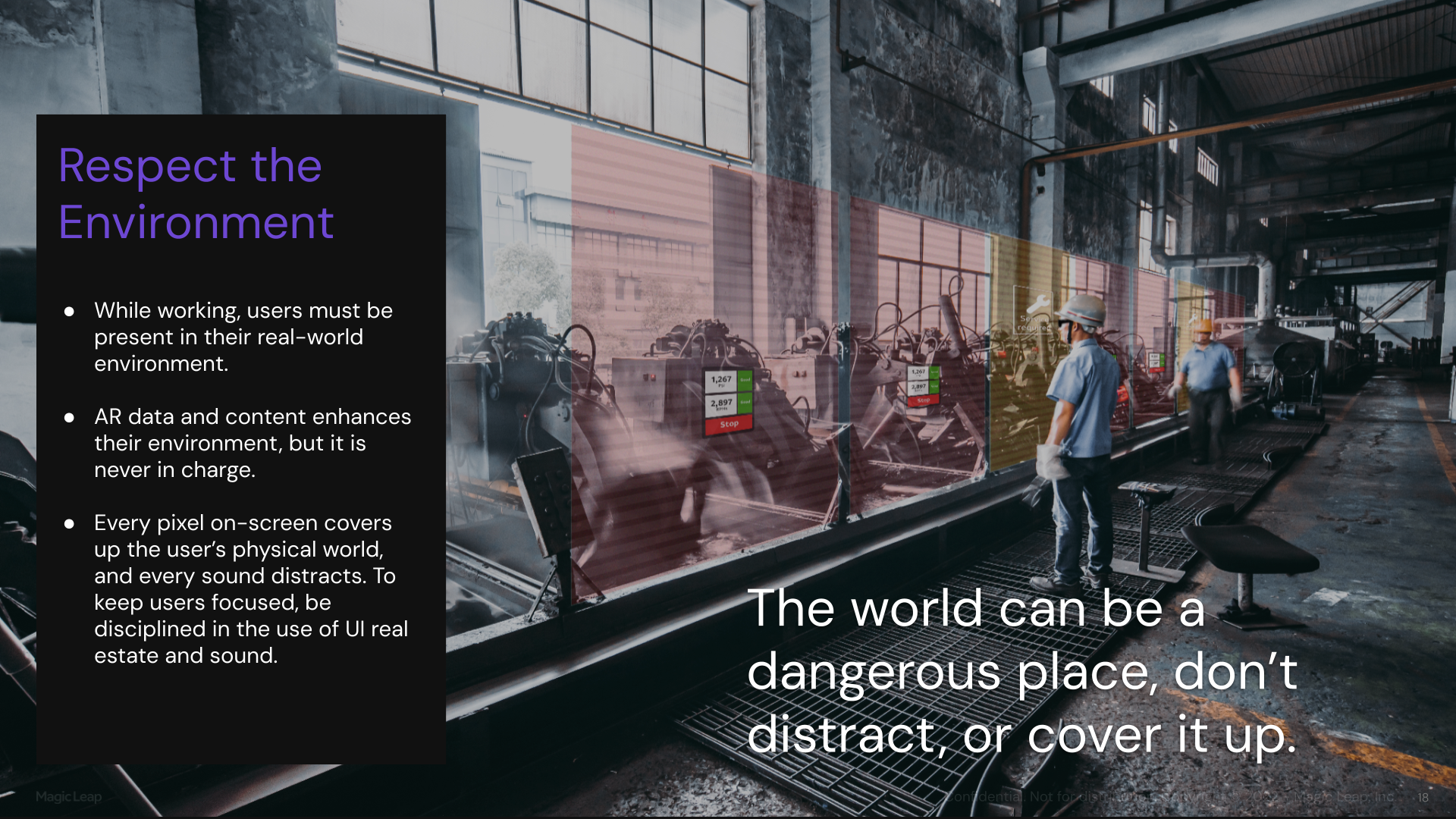
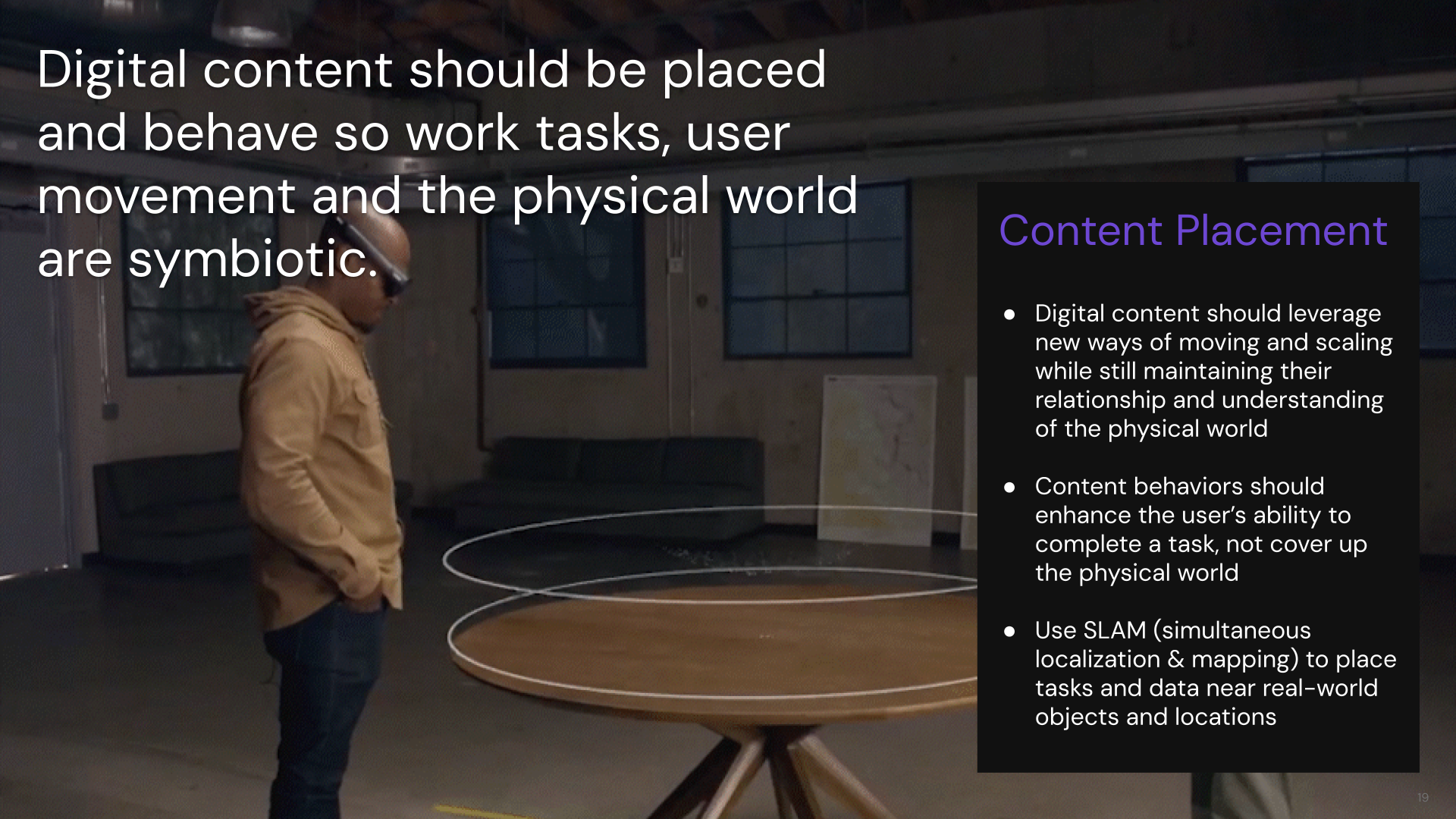
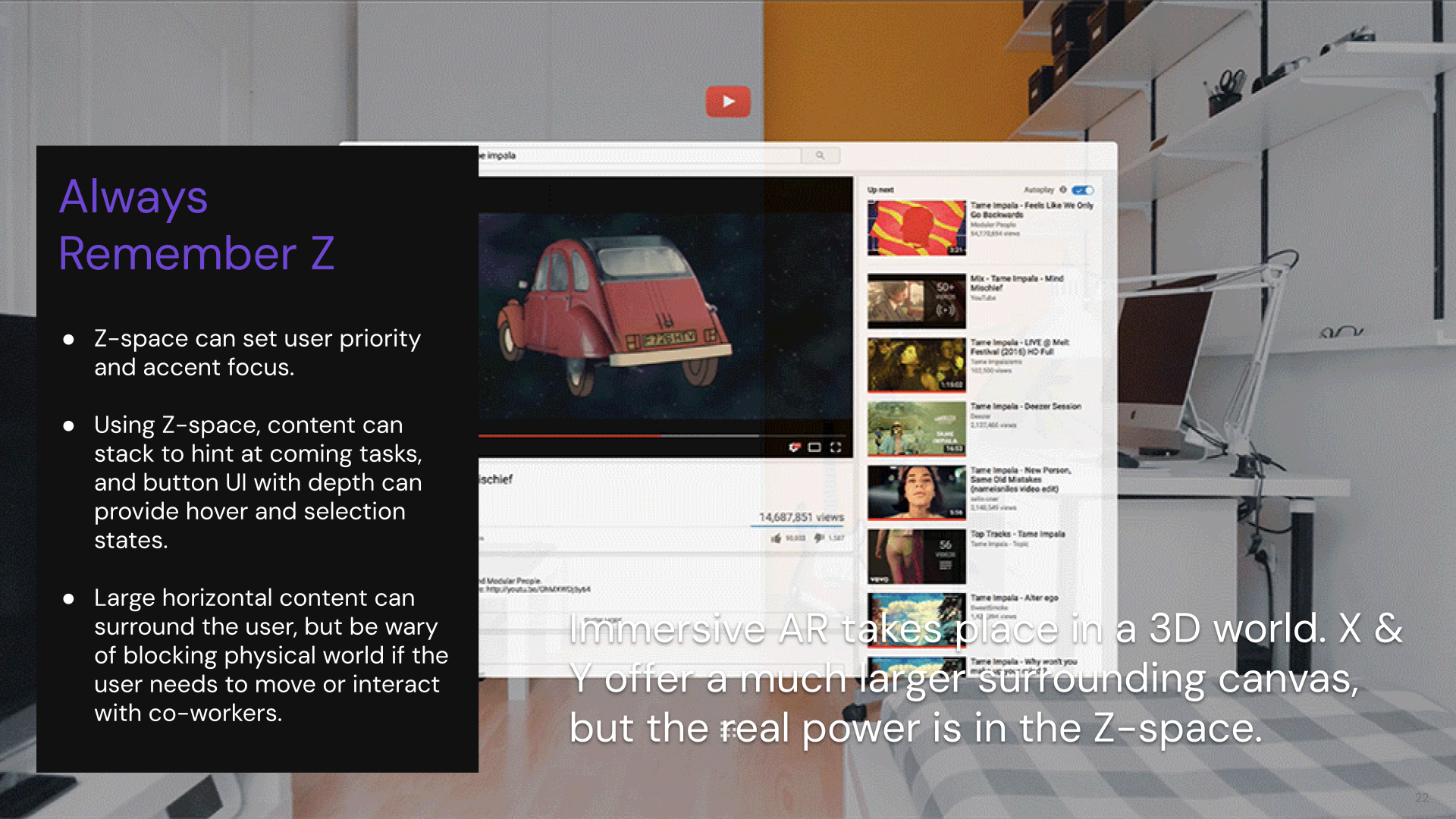
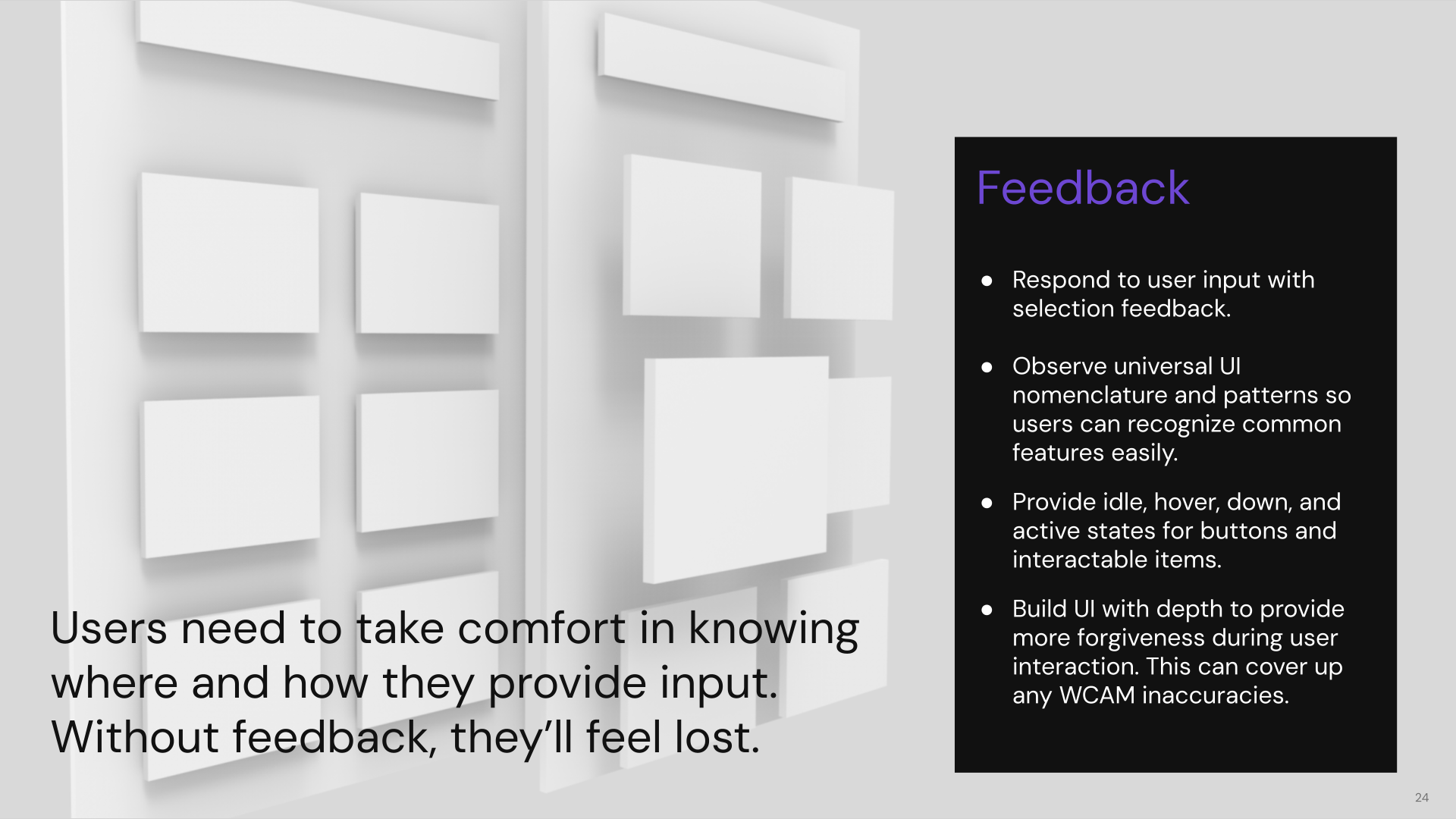
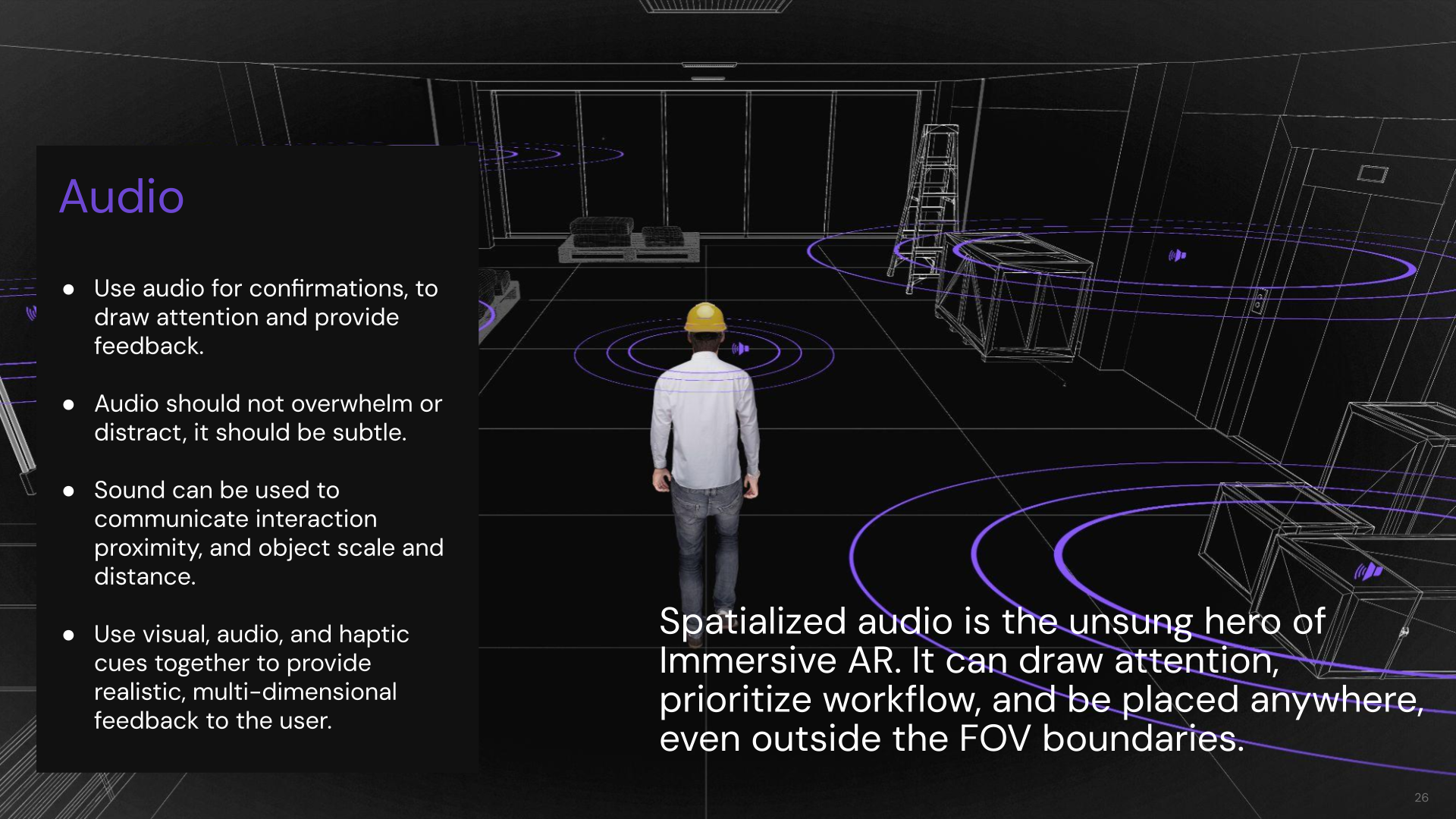
This original document included deeper explanations of how to achieve these basic principles, all of which would eventually filter down into Guidelines documentation.
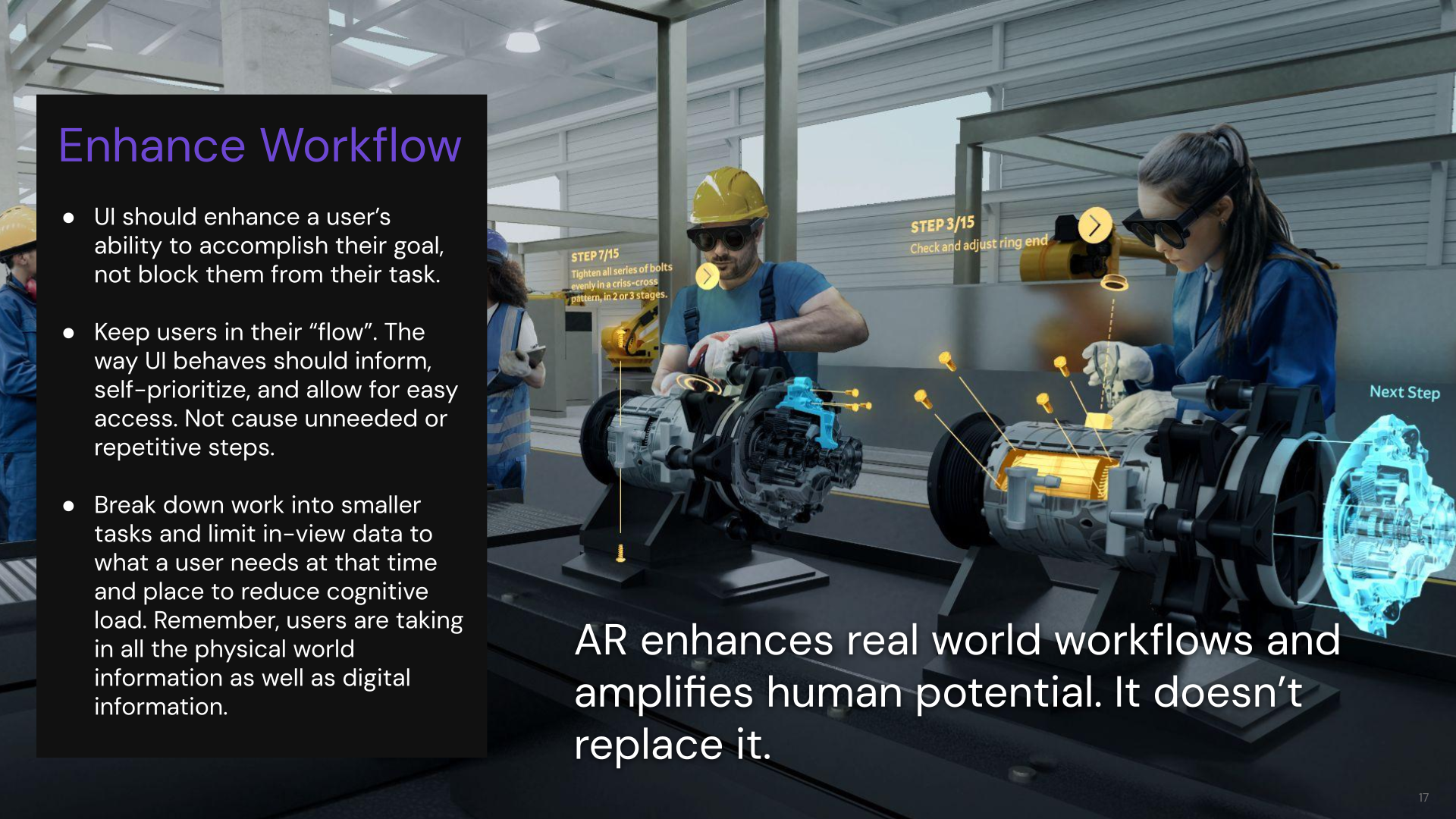
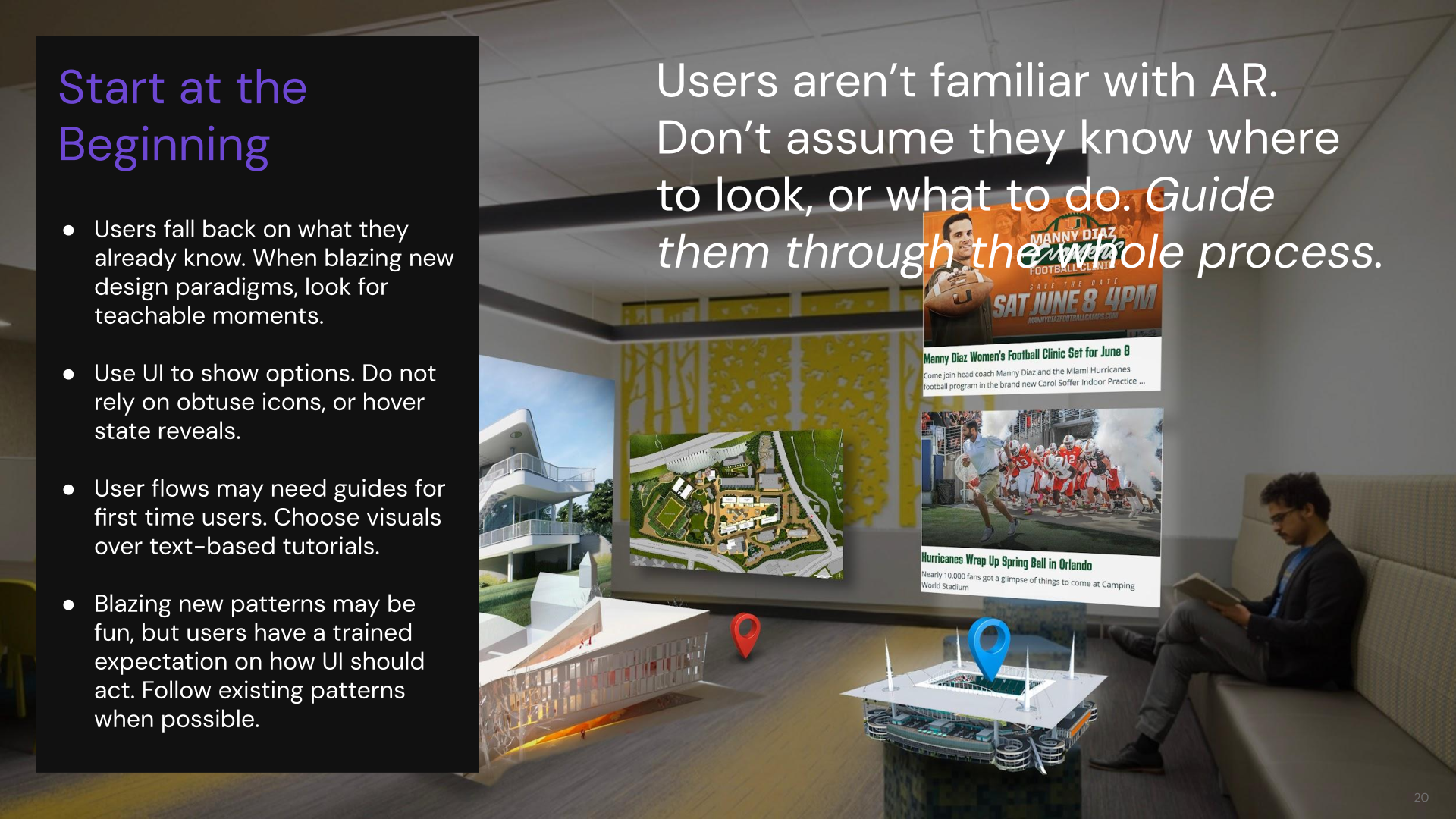
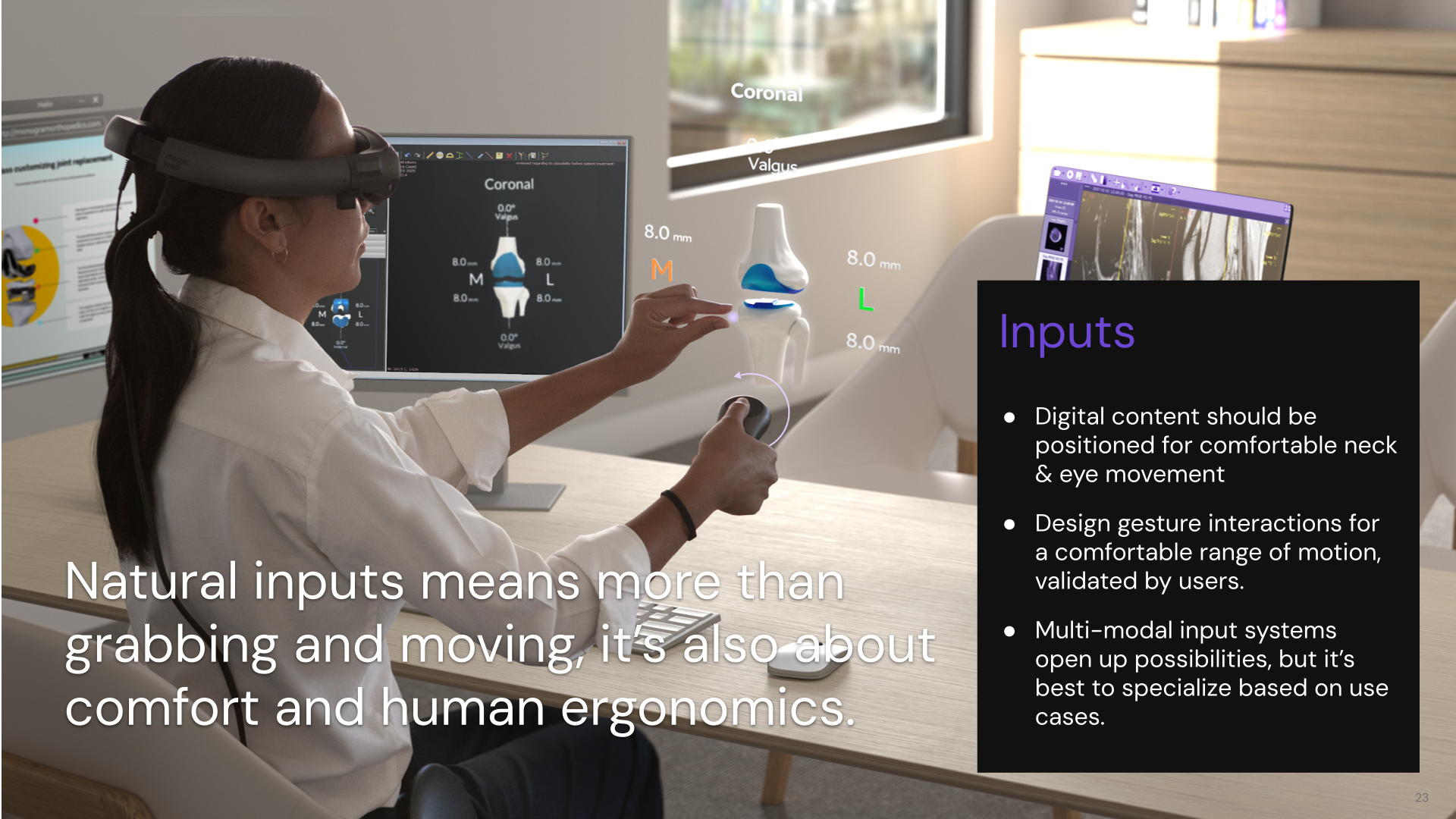
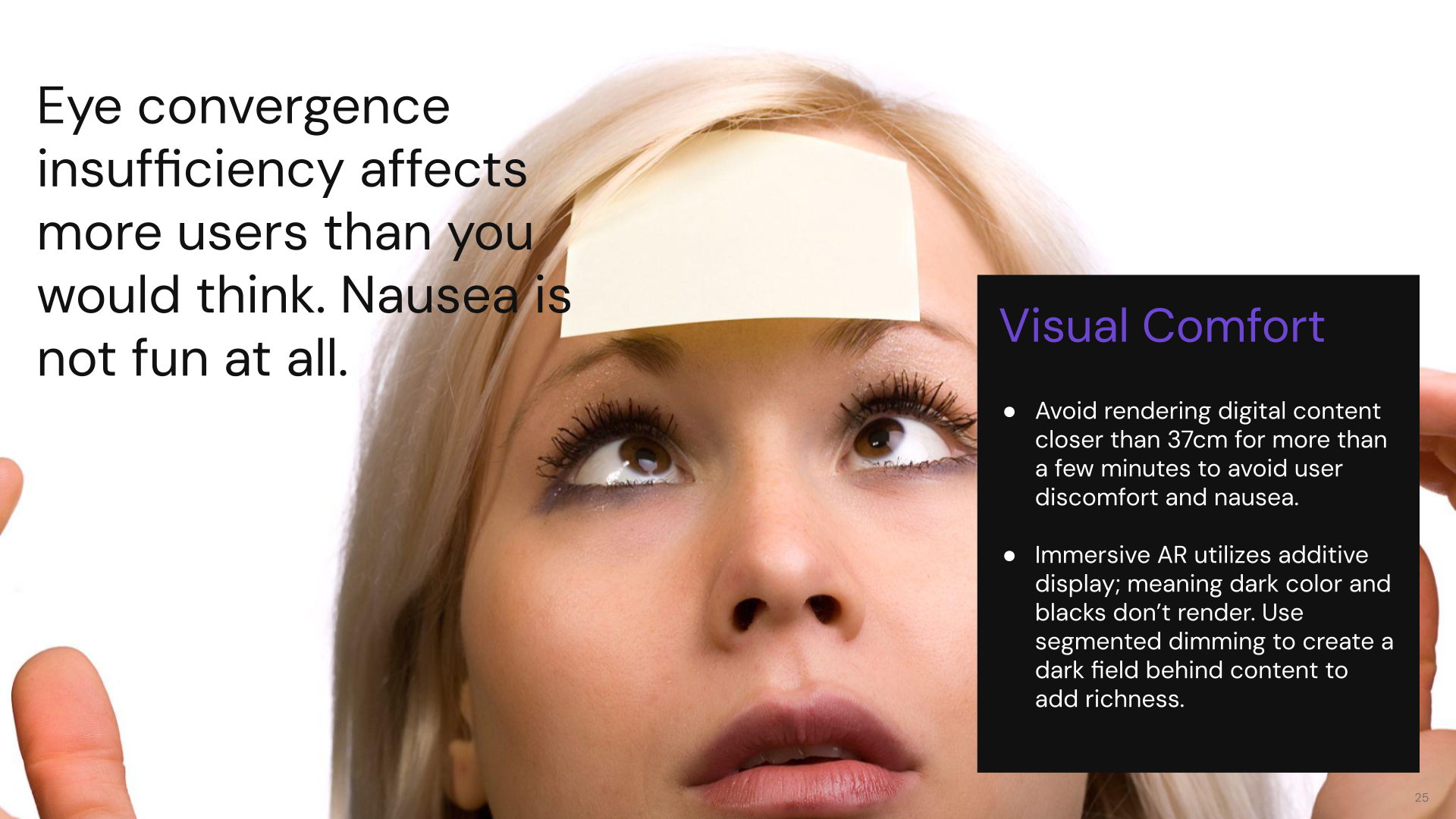
It’s official, we’re building our principles
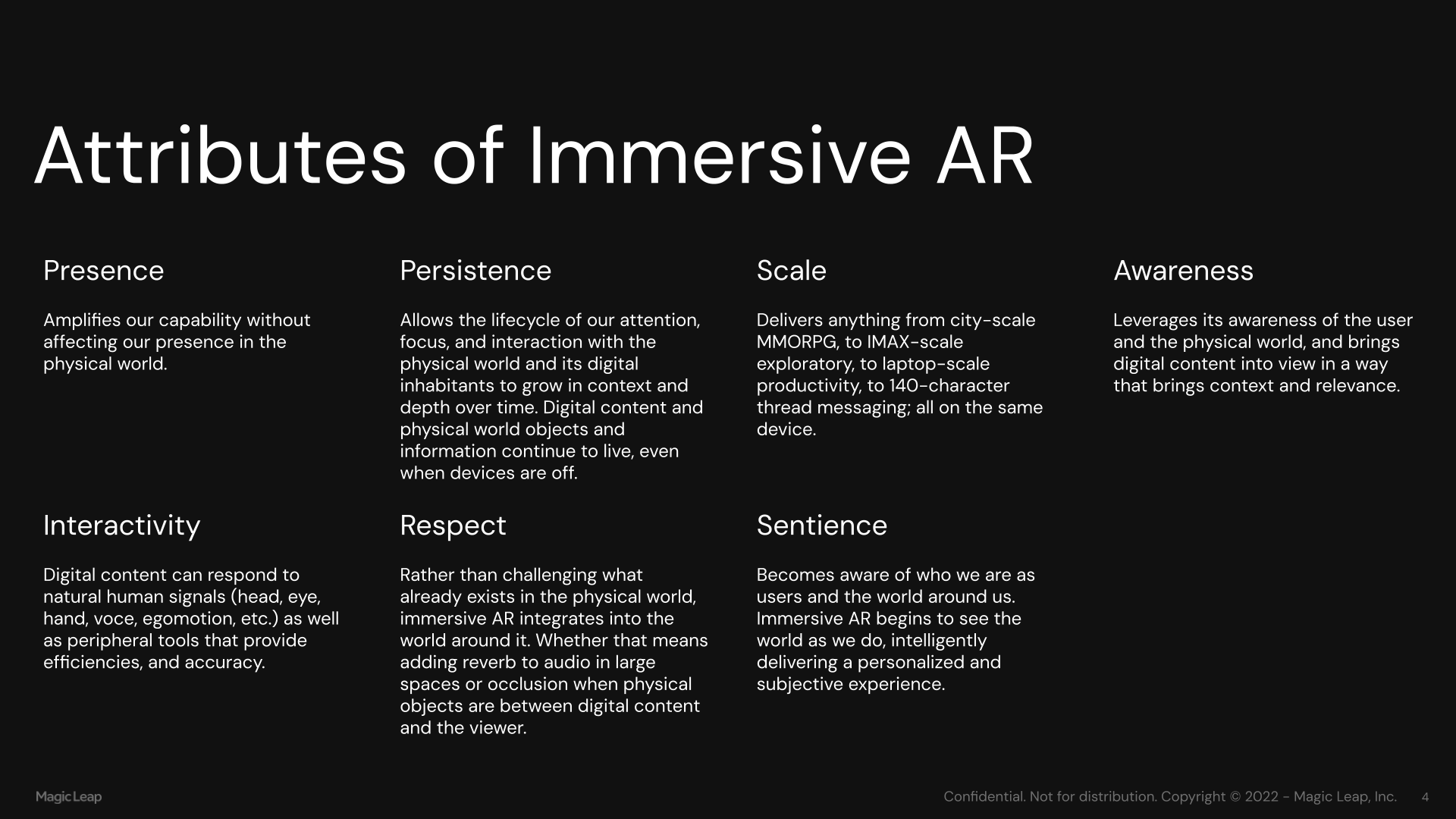
I was asked by ML leadership to translate and adapt this slide deck into official AR Principles to be shared with the AR community and to showcase Magic Leap’s AR design leadership. I started by listing out the attributes of Immersive AR: presence, persistence, scale, awareness, interactivity, respect, and sentience.
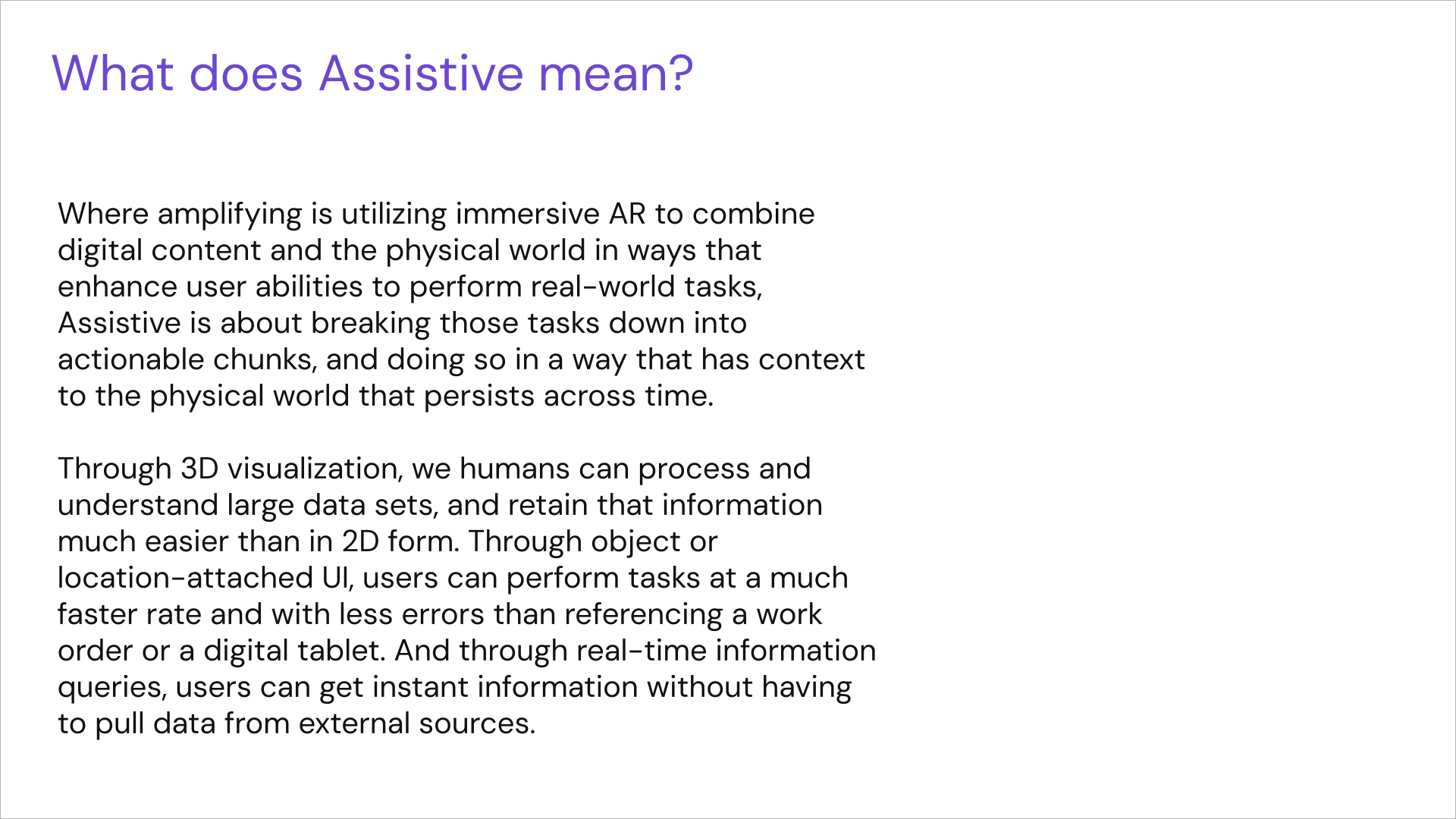
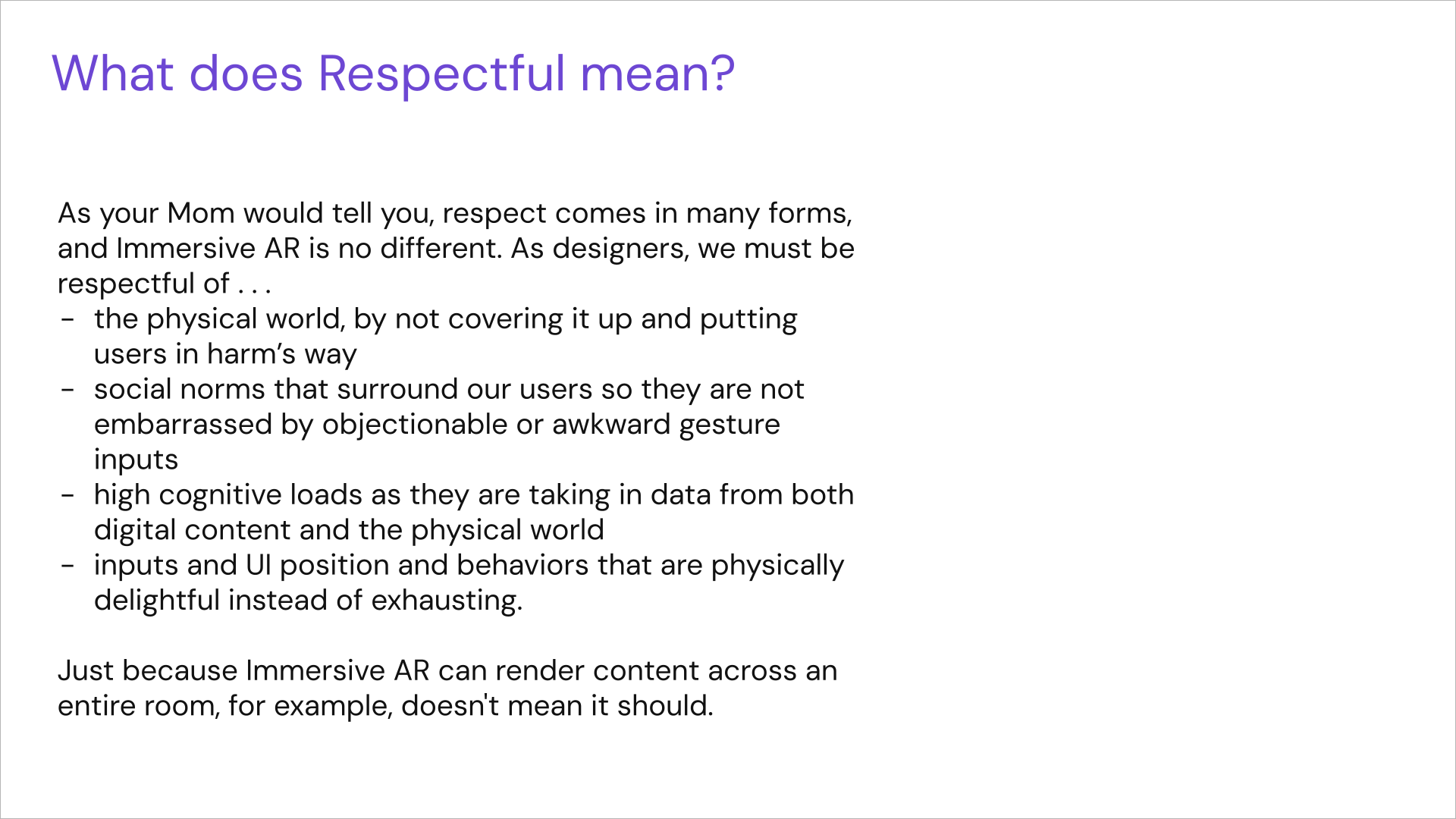
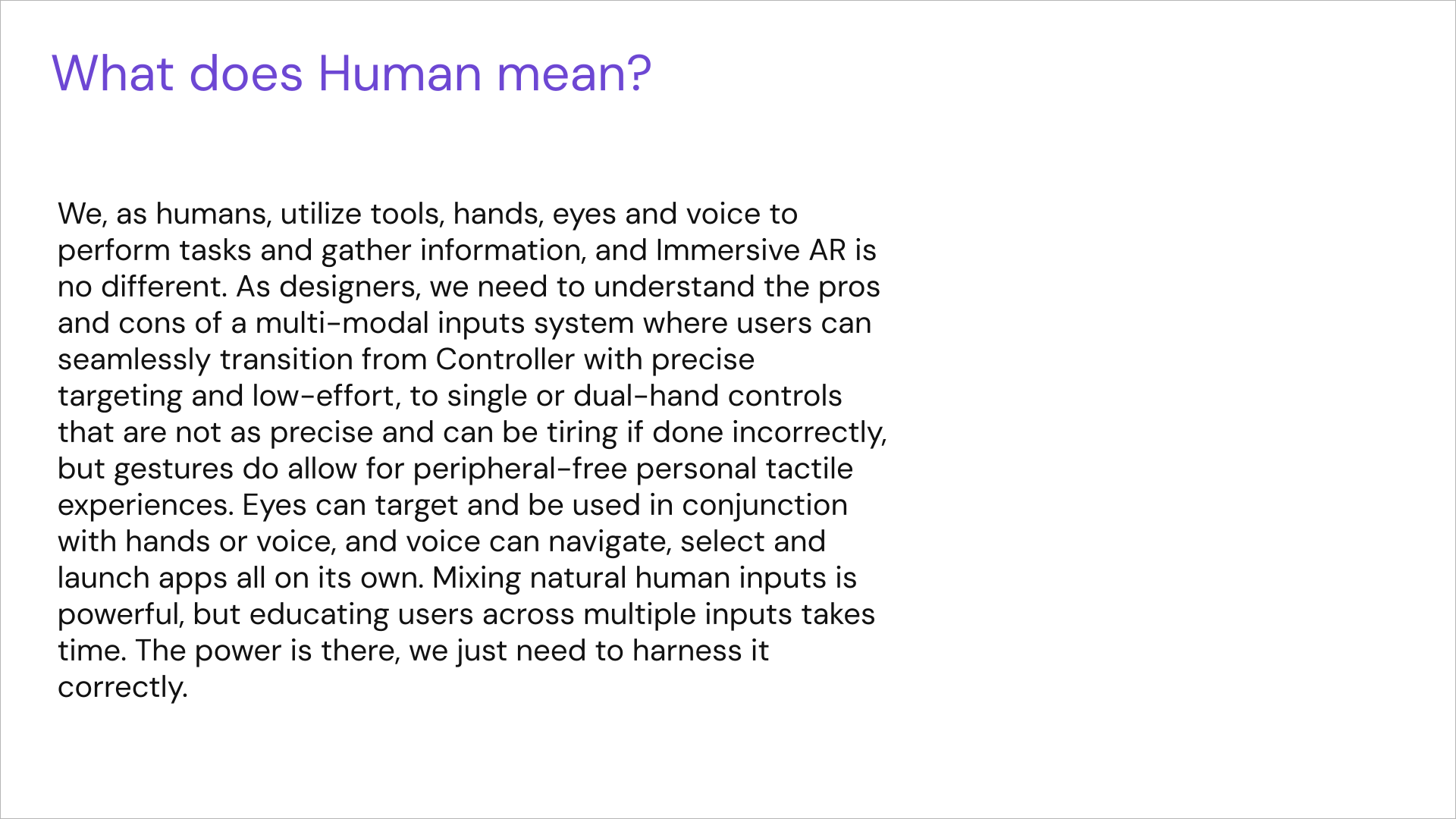
I reviewed the eight principles our design group had written against these attributes: Uncomplicated, Inspiring, Intuitive, Humanistic, Focused, Flexible, Empowering, and Purposeful. I then scaled down and adapted these eight attributes into four: Amplifies, Assistive, Respectful, and Human.
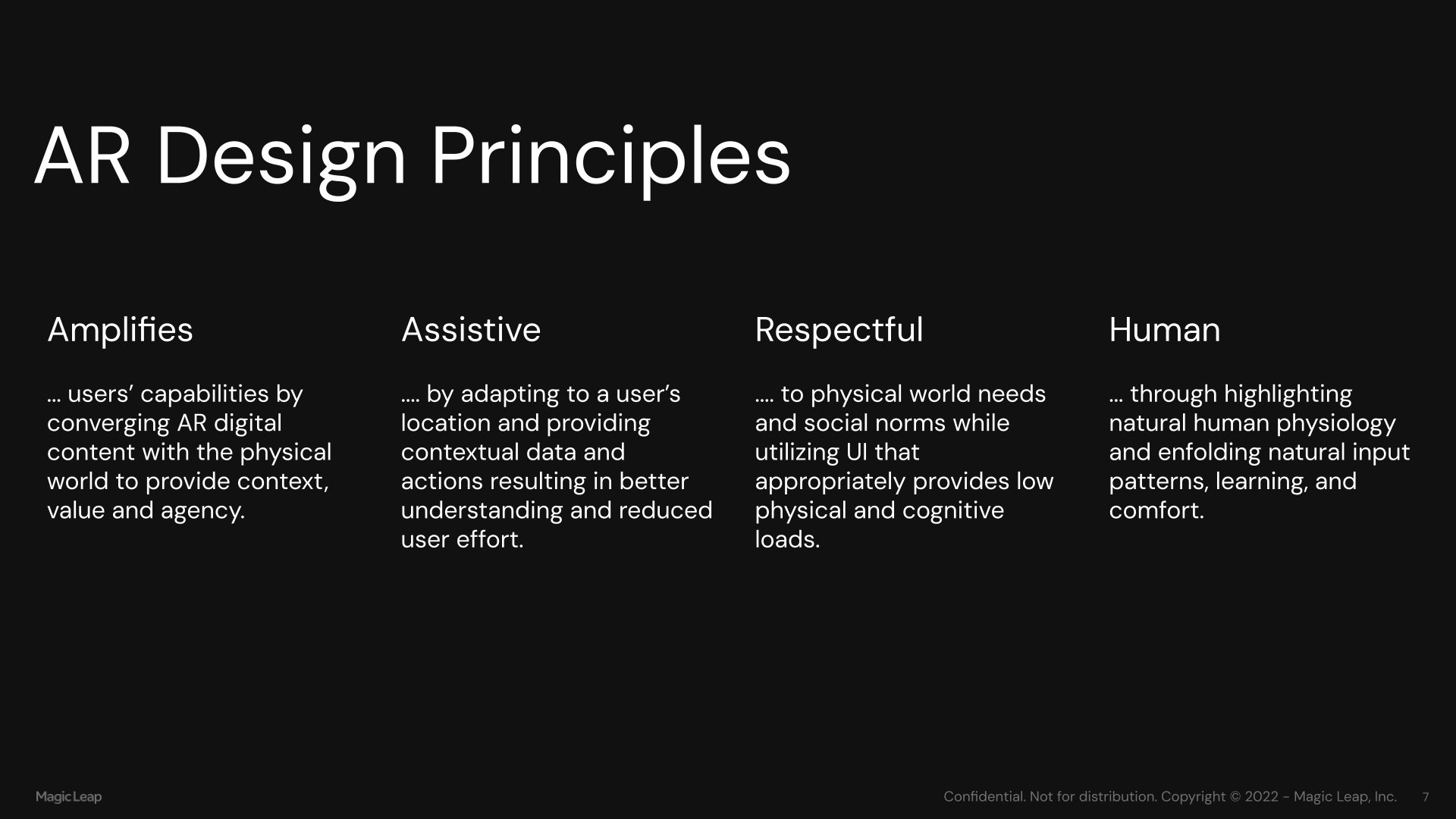
I wasn’t totally happy with where I landed because the original nine categories I had created did not fit neatly within the confines of the four revised principles. I pressed forward just the same and attempted to further explain what they meant, using both aspirational language and practical explanations.
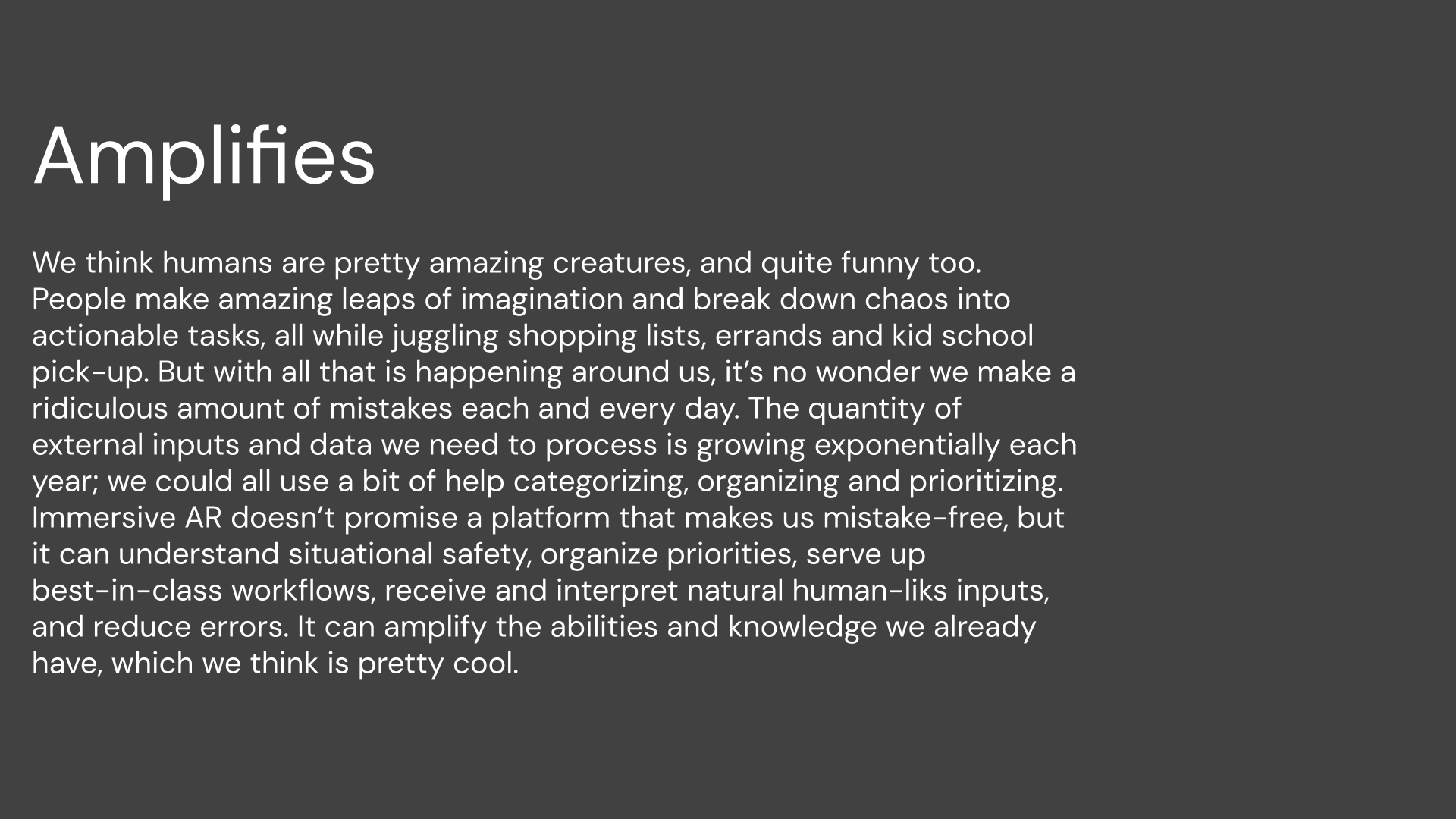
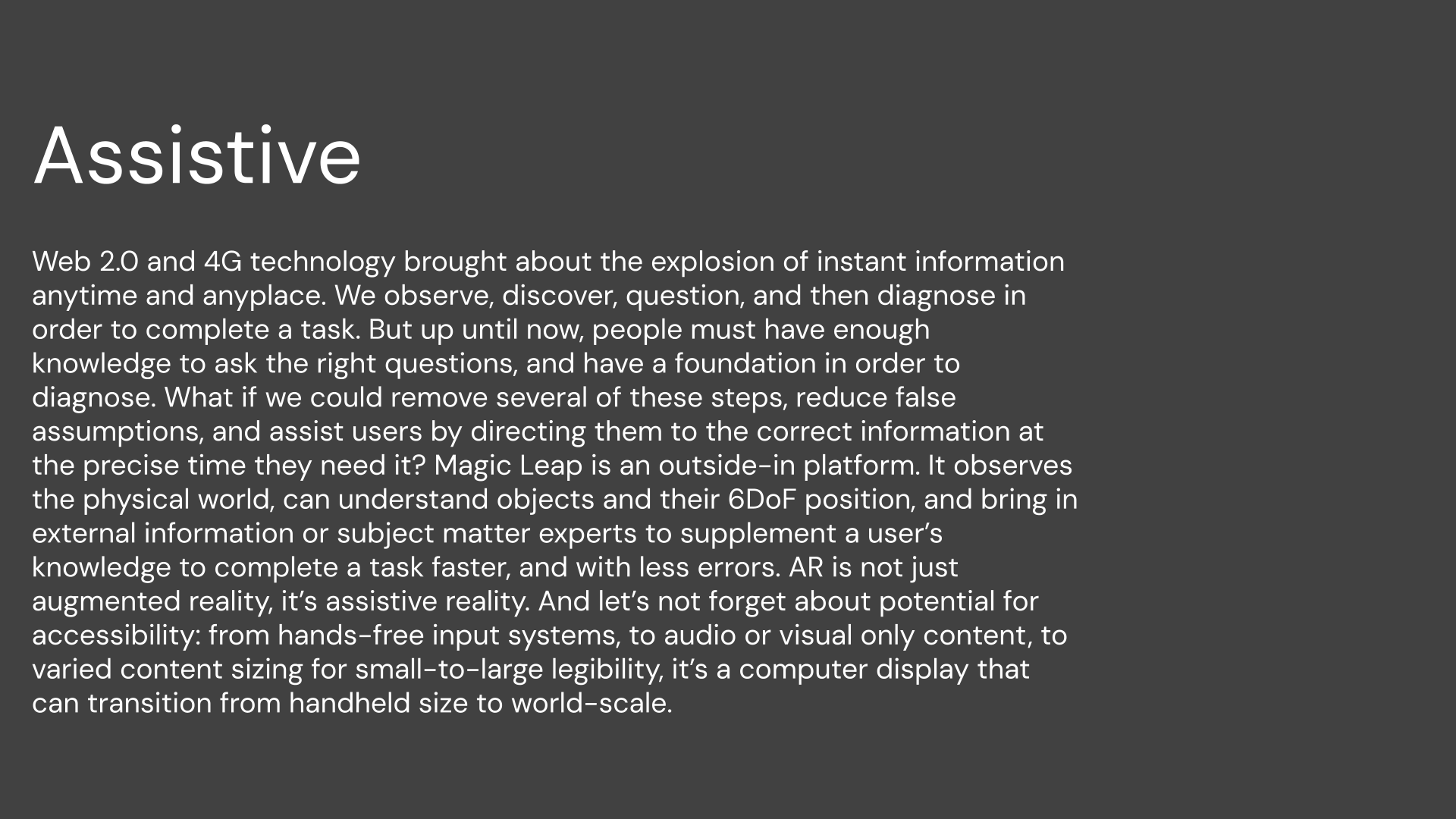
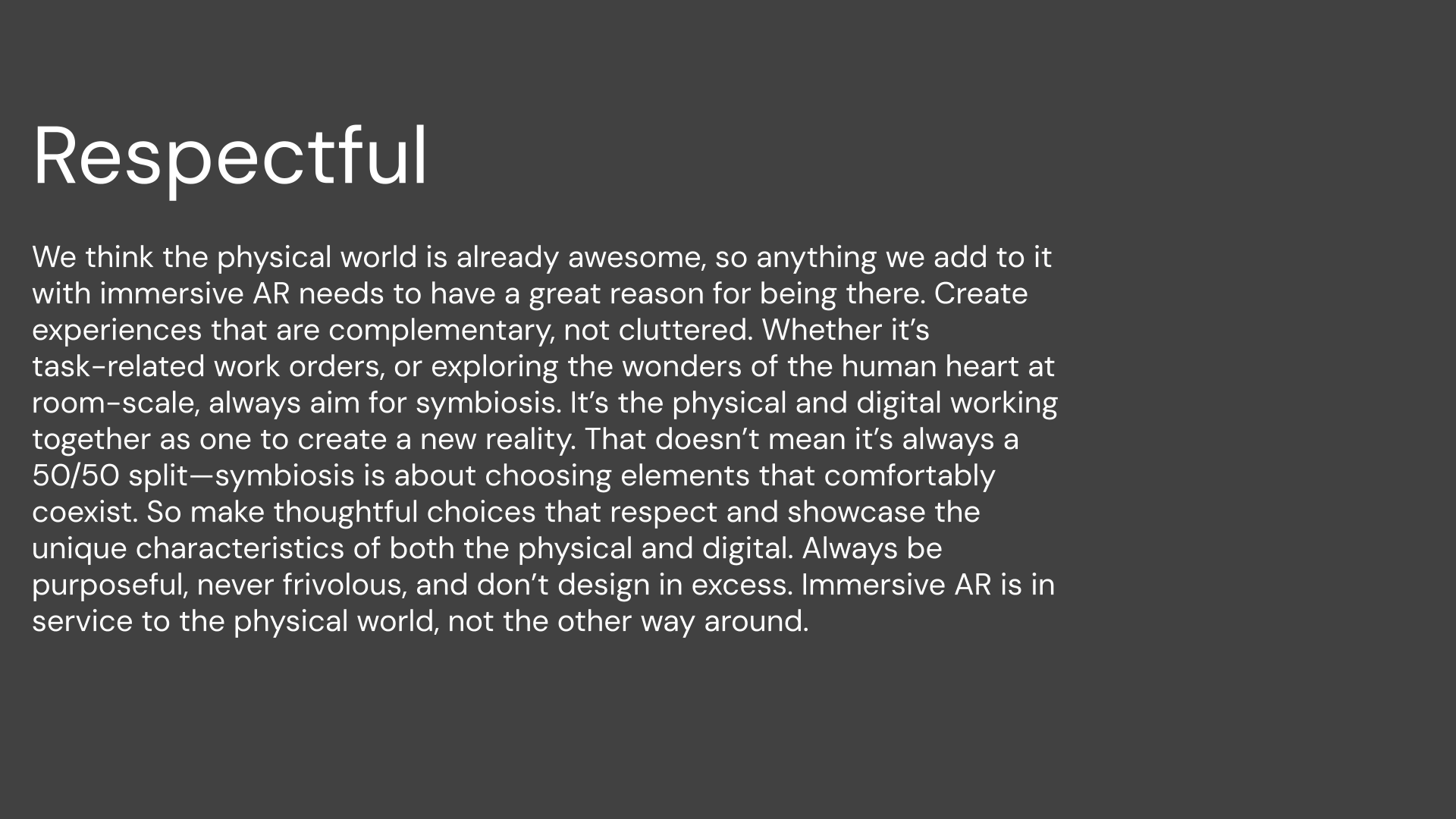
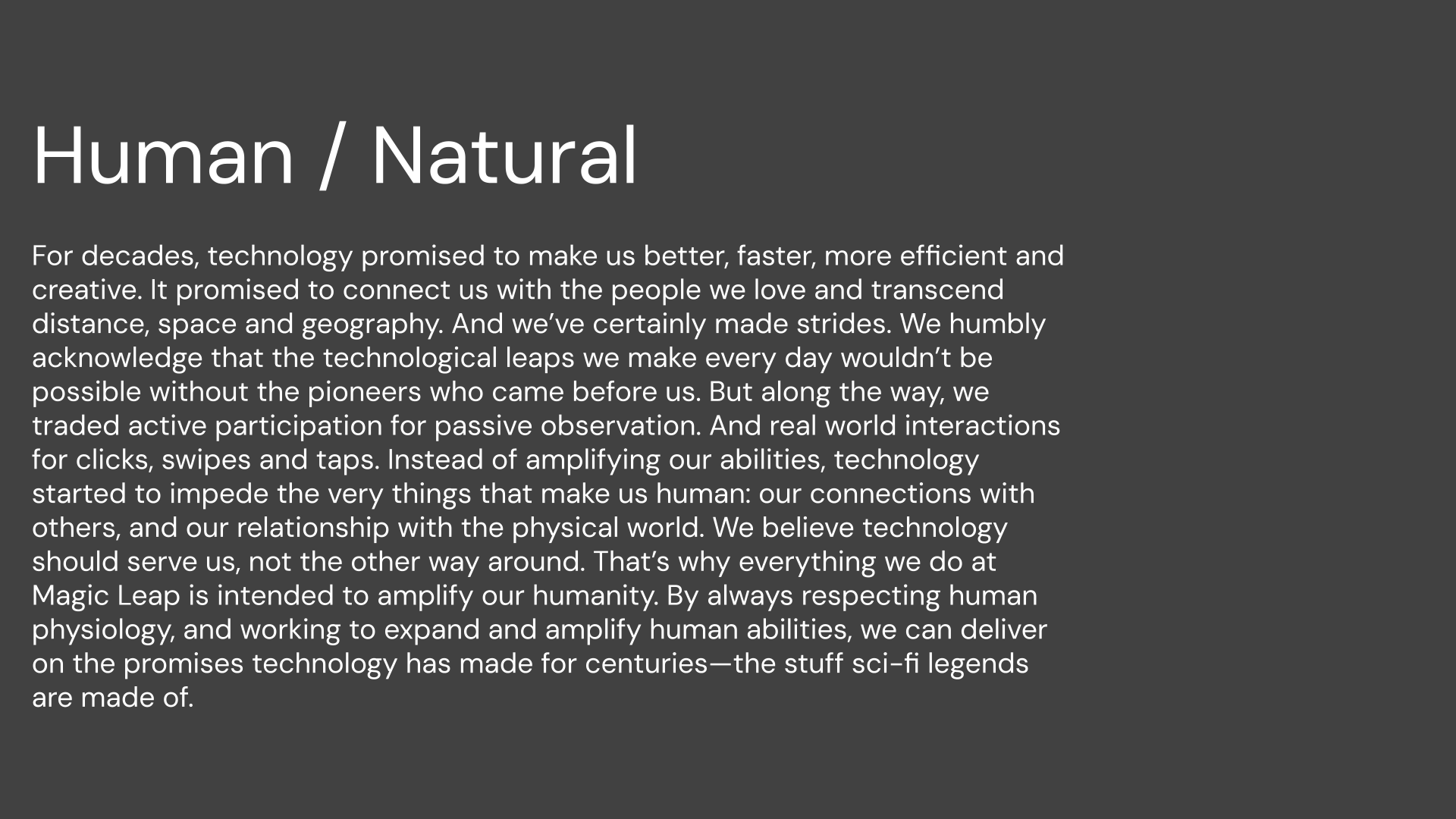
Once I wrote it all down and started trying to realign attributes to each principle, I found I was in over my head, and it was all becoming a hot mess. I worked with design leadership to help me categorize my thoughts, and we realized we might engage an agency that specializes in messaging. Enter ManyOne.
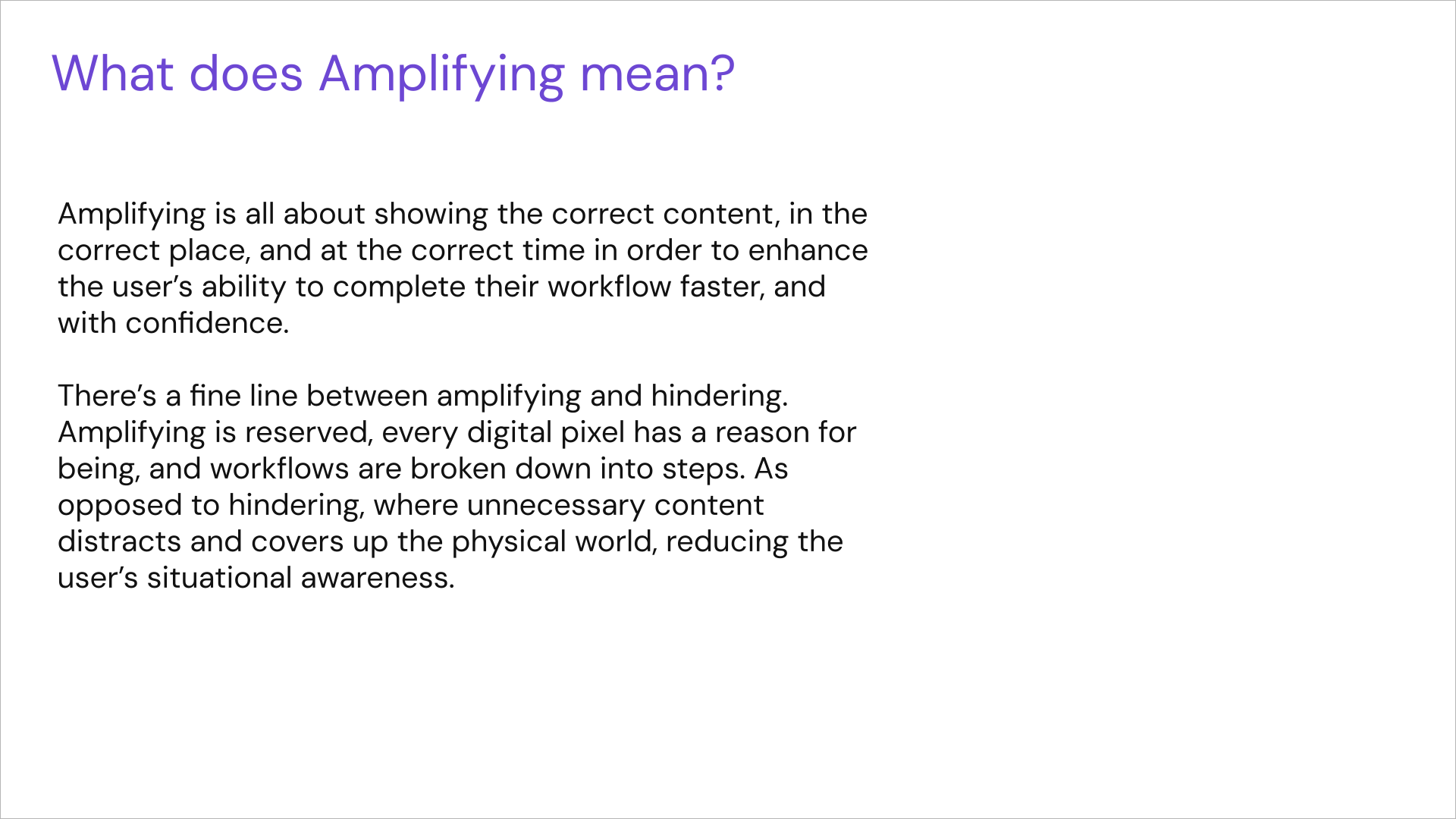
The Messaging Experts
Over the next few weeks, ManyOne, a team of messaging and visualization consultants, interviewed design leadership and me, and reviewed all my documentation to immerse themselves in AR design. At this point, they led the effort to define principles, review competitor messaging, and recategorize.
The objective of ManyOne was to create principles, definitions, best practices, examples, and on-brand visuals. The whole process took about 10 weeks, and they did a great job of creating actionable, inspirational principles accompanied by beautiful supporting visuals. They had taken what I started, wrapped it in a nice container, and made me look good.
Be present
Understand context
Embrace human abilities
Harness human intention
Spatialize with purpose
Build intelligent interaction
Still not quite right
After sitting on the final output from ManyOne for a few weeks, it all felt a little too complicated. In design, simple is the hardest thing to achieve, but well worth the extra effort. We need principles that are easy to reference, categorize, and memorize. Additionally, the best practices for each of the ManyOne principles tended to bleed across principles, making them feel redundant.
Final artifacts
We dove back in and reduced the total number of principles to three, and then recategorized and revised the best practices.
Respect reality
Embrace human abilities
Spatialize with purpose
With this new and reduced list of principals, everything fit nicely. Each principle was clear, concise, easy to remember, and easy to understand. The final step was working with our visual designers to repurpose the ManyOne visuals to create the final artifacts. We built decks to share internally across design and product, and externally with 3rd party developers. We added the principles into developer documentation, the marketing team compiled social posts, and coffee table books were printed to hand out to customers.
AR Guidelines
The detailed documentation of building out AR Guidelines for in-depth information on how to design, build, and implement everything from comfort and inputs to art pipelines and button sizes was a tedious process, and not one that is fun to talk about. So I will keep this brief, even though it is essential to ensuring quality app development.
I began by pulling together all our old ML1 guideline documentation as a starting point, then just got to writing. After about three weeks of effort, I had a 227-page document with 12 categories: AR 101, Design for Comfort, Design for Magic Leap, Input Methods, Shared Experiences, Visual Design, Audio Design, World Understanding, Dimming, Accessibility, Privacy & Security, and Capturing Videos. I was able to write almost every section based on what I knew, but in several areas I had to lean on subject-matter experts, such as in the Audio Design category. Supporting visuals were created by the visual design team and then released on the developer portal.